Sunday, 19 October 2014

Return to Alderley Edge.

The View From Stormy Point

How Alderley Edge fired me up about photography.


I first read about Alderley Edge, not realising at the time that it is a real place, in the Alan Garner novel, "The Weirdstone of Brisingamen". This was while I was an inmate at school in Richmond, Yorkshire, sometime in the early 1970s. At about the same time, I read "Earthfasts" by William Mayne, a similarly fantastic story, set in the real location of Richmond, and weaving its narrative from elements of local legend, local landscape, and time travel. Both books were exactly the kind of story to appeal to my imagination, and when I finally realised that Alderley was a real place too, and that the Legend of the Wizard of Alderley Edge was similarly a "real" legend, the spell was complete.

Eventually my parents moved to Wilmslow, where they lived for several years, and I was then able to discover the actual Alderley Edge for myself. I became so fascinated by the story that I spent many hours along and around the Edge, trying to identify all the crucial locations referred to in "The Weirdstone of Brisingamen". And, in a 'weird' way, the book was instrumental in my becoming a photographer: so obsessed did I become with the real places described in the book, that I decided to produce a photographic guide book to "The Weirdstone ...". I had recently borrowed and begun using an SLR for the first time, and under the impetus of taking the photos for the guide book, made a real effort to learn more about photography.

The Entrance To The Devil's Grave on Stormy Point

Needless to say, the guide book never happened. However, I did discover that I was genuinely interested in photography, and eventually went on to study photographic technology at Manchester Polytechnic.

The obsession with "The Weirdstone ..." continued, and culminated in a re-creation of the journey, made by the main characters at the end of the book, between Alderley Edge and Shutlingsloe, a hill above Macclesfield Forest in the Peak District. In the story the children, in the company of warrior dwarves whose duty is to protect them, must travel from Fundindelve, the Wizard's home beneath Alderley Edge, to meet Cadellin the Wizard on the summit of Shutlingsloe. They are pursued by Witches and a variety of mythological monsters, so the route that they follow makes its way across country, taking advantage of all the landscape features that will give them cover from their pursuers. Our re-creation, though, was constrained by the modern necessity to follow rights of way, so much of the central part of the route was unable to follow the original.

The Wizard Of Alderley Edge

There is a short section in the book, as our heroes attempt to pass unseen by the pub in the village of Gawsworth. To our delight, the Harrington Arms is a real pub, and back then (late 70s - early 80s) was relatively untouched by modernity. Indeed, until 1984, when Robinson's Brewery gave the bar a bit of refurbishment, there was no bar - beer was dispensed by gravity from casks laid down behind the serving counter. The then-landlady, Marjory Bayley, was as likely to sell you potatoes as beer, and although she cultivated the outward appearance of being a curmudgeonly elderly lady, she was always very kind to me and my friends (one cold and wet New Year's Day, despite the fact that we turned-up late in the afternoon, she rescued us from starvation by producing a plate of sandwiches long after the lunchtime period was over).

So, despite the fact that we were forced by circumstance to make our way to Shutlingsloe via public rights of way, we were still able (indeed we made a point of it) to call into the Harrington Arms for lunch. Afterward, the summit of Shutlingsloe was achieved without much difficulty, but was not the end of our journey. We still had several miles farther to go (mainly downhill, of course) to get back to Macclesfield Railway Station, to catch the train back to Manchester.


Engine Vein Mine
I moved to Kendal in 1987, and it was to be many years before I would set foot on Alderley Edge again. We had occasional flying visits, when we might manage an hour to walk out to Stormy Point and Castle Rock. When we did, I was struck by just how small and urban the Edge seemed to be. Yet when we lived in Manchester, and Alderley was our regular 'Escape to the Country' it felt positively like wilderness. How perceptions change.


The Wizard's Well
I recently had an opportunity to return and have a proper look round again. The photographs here in this post are from that occasion, and the full set of pictures can be seen on my Picasa gallery. I intend (and it is worth remembering that the road to hell is paved with good intentions) to dig out some of my old photos from the 1980s, and display them here as a comparison with the new pictures. Anyway, the weather on the day of my excursion was excellent, and I managed to get a reasonable walk under my belt. I went to all the old familiar places on the Edge proper, but also had sufficient time to make my way across to the other side of the Macclesfield Road onto the South side of the slope. I was quite surprised to find that, although much was familiar, there was quite a lot that I did not recognise. Not that anything had necessarily changed, just that my memory is becoming increasingly unreliable.


Shutlingsloe, the Scene Of Armageddon in the Weirdstone
One disappointment was to find that many of the old quarry and mine workings have been 'made safe'. Entrances to tunnels have been walled-in or had doors fitted, and quite extensive areas have been fenced - presumably to reduce the risk of someone tumbling over an edge. And yet Castle Rock, which has a genuine long drop, is still unencumbered and allows the bold or the adventurous the opportunity to dangle their legs over the abyss. Political Correctness Gone Mad!


The View of Jodrell Bank from the South Side of the Edge

And so I say to all who may have read Harry Potter: forget that bloated, overwritten, exploitative claptrap! If you want to see how a tale of Wizards, magic and fantasy should be written - with economy, style and grace - read Alan Garner's "The Weirdstone of Brisingamen". And then visit Alderley Edge, to see how such a tale can inhabit the real world, without the need for Diagon Alleys, or Platforms of fractional numericality.

Monday, 14 April 2014

Alexander's Ale Festival, 2014

Autumn colour at Alexander's, the Pub at Castle Green

The 2014 Edition of the Alexander's Ale Festival, held in the Function Room of the Castle Green Hotel, got off to a flying start on Friday April 11th. with several of the Bowness Bay beers selling out on night One!  Thankfully, Saturday afternoon started in gently, giving time and space for quiet contemplation of the beers on offer.


Three glasses of beer
 (How did John Smiths Smooth get in there? It's a bloody Beer Festival!)

Top performers, based on a straw-poll of those present, were: Swan Black, from Bowness Bay; Billonde, from Brewshine (apparently made by a man from Kendal in his garage); American Hop from Lancaster Brewery; and (definitely the winner) Angram IPA from Tigertops Brewery in Wakefield. Tigertops is owned by the same people who bring us Foxfield beers from the Prince of Wales pub at Foxfield, and the Angram IPA was a refreshing blast of citrus and hops right from the word go.

 The sun eventually came out, although it was too breezy to sit outside for any length of time. Alexander's, the Pub at the Castle Green Hotel, truly has the finest situation of any pub in Kendal. The Ale Festival, taking place as it does in the Function Room, enjoys much the same view, and when the sun shines, if it's warm enough, you really can't find a better place to enjoy a beer than the hotel lawn.


Live entertainment was supplied by The Mustard Cutters. By common consent, they really "Cut The Mustard" on the night, performing numbers that were clearly popular with the audience, and getting large numbers on the dance floor as the evening went along.

You can see an album of photos of the Ale festival, including lots of The Mustard Cutters, by clicking this link.

Sunday, 18 August 2013

This may not be the real world that we think it is ...

When I was a child, because my Dad was in the army, my family and I spent short periods of time living abroad in a number of different places. This involved a lot of travelling. At that time I had the uncomfortable feeling that we never actually travelled anywhere at all. I couldn't shake the idea that when we got into an aeroplane at, let's say, Luton Airport, and then landed in Germany, we hadn't actually left the ground at all. All that had happened was an unknown group of (possibly alien) manipulators shook the plane around a bit to make it seem like we were flying, and while that was going on, all the scenery and people were moved around. When we got off the plane some hours later, believing ourselves to be in Germany, we were actually still in the same place we had always been - but we didn't recognise it, and all the (maybe alien) people had started to talk in German.

The feeling stayed with me for years (and if I am honest, has never really completely gone away) and was reinforced when I read a sci-fi story about just such a delusion suffered by the main character. In the story, it transpired that he was not deluded, but was really living in a constructed reality as part of a mysterious experiment by aliens. And more recently the film "The Truman Show" has put another spin on a similar theme.


In September 2011, Fiona and I made a visit to Liverpool with friends Susan and Leigh, in part to see an exhibition of works by Rene Magritte at the Tate Liverpool. I was most familiar with Magritte as the author of the painting "La Trahison des Images (Ceci n'est pas une pipe)" ("The treachery of images (This is not a pipe)"). I occasionally used it in Photography classes to encourage students to consider what an image is:

Me (passing round the picture): "What is this?"
Student 1: "It's a pipe."
Me: "Anyone else?"
Student 2: "It's a picture of a pipe."


Back to the Tate exhibition. Much of Magritte's work focusses on the problems of perception, and the pieces in the exhibition that I found particularly fascinating have titles that seem to be significant to their meanings. "Evening Falls" seems an obvious double meaning, referring both to the setting sun outside the window, and to the broken shards of glass littering the floor. "The Human Condition" though, with the easel in front of the window, is more enigmatic. These two pictures, being more 'landscapey' than much of his work, got me thinking about the ideas of place that they aroused in me, and recalled my childhood paranoia about never actually traveling, and which I equate with my uncertainties concerning my control over my life.


This led to the idea for the picture that I have called "Memories of Childhood" (above). When I made the picture, I had not got a photograph of a suitable window; but I remembered that I had some interior views of a Shepherd's Hut from a holiday in Dorset in 2010. I thought that one of the pictures would suffice for a first trial - what would it be like to discover that my fears from all those years ago were justified, and that everything I do is being monitored by some other being, peering in through a gap that occasionally appears in the fabric of our universe? To add to my present confusion, some current thinking about cosmology, and some arguments about perception, lead me to a supposition that the world depicted in the Wachowski Brothers' movie "The Matrix" may not be that far off the mark!

The second image (to the right) is an early attempt at recreating the "Evening Falls" image, made from the view from Susan and Leigh's room in the hotel where we stayed in Liverpool. (Or should that be "made from an image of the view from Susan and Leigh's room in the hotel where we stayed in Liverpool?)

Things are not what they seem.

Monday, 20 May 2013

Another Blog, a sort of Beginner's Photography guide


I have started another blog, based on the beginner's photography classes that I used to run. It is called "Get to Know Photography - Some Basic Principles", and you can find it by clicking on the link.


Monday, 13 May 2013

The Punctum of Time

How the most mundane of snapshots can catch you unawares.

In the opening paragraph of "Camera Lucida", Roland Barthes mentions having seen a photograph of Napoleon's brother, Jerome, taken in 1852. He was amazed to realise that he was "looking at eyes that have looked at the Emperor". Now, this is not meant literally, but it does give rise to thoughts about the way that we are prepared to accept a photograph as being “real” in some sense.

Later, in Chapter 32, he describes photography as proof of the fact that "the thing has been there"; painting can "feign reality", and spoken or written language can deceive, but it can always be said of a photograph: "That Has Been".  The nature of the photographic process means that light from the referent (the original real object or person) creates its image in the photograph. When the image is eventually seen by a spectator (by you or I) that light from the referent, delayed by a period of time, finally reaches the spectator. Barthes describes a photograph as "literally an emanation of the referent". Again, this light from the referent is not literally the same light that, passing from the referent to the film emulsion, caused the original exposure. This idea of ‘deferred light’, finally reaching its eventual audience, is more concerned with the fact that every photograph is inevitably of the past. However, there are quantum physicists who might argue that, because one photon is practically indistinguishable from another, there is no way to prove that the light emanating from the photograph is not the same as that from the original exposure.

In the latter part of the book Barthes is discussing a photograph (referred to as the Wintergarden photograph) of his (recently deceased) mother as a young girl. We are not shown the photograph, a snapshot, since Barthes considers that it would appear mundane to anybody but himself, and thus appear incomprehensible as an example of an important photograph. Yet in studying the photo, he "rediscovered" his mother in "the treasury of rays which emanated from my mother as a child, from her hair, her skin, her dress, her gaze, on that day".

Lewis Payne, by Alexander Gardner, 1865
In chapter 39 there is a photograph, taken by Alexander Gardner in 1865, of Lewis Payne in his prison cell awaiting execution. Barthes had the realisation that, in addition to the punctum of 'the detail', there can be, as in this photograph of Lewis Payne, a punctum 'of Time'. In the photograph (evidence of "That Has Been") he is alive and well; however, we are also aware that, at the moment that the photograph was exposed, he is about to die, and that he is dead (in the here and now), and has been for many years.

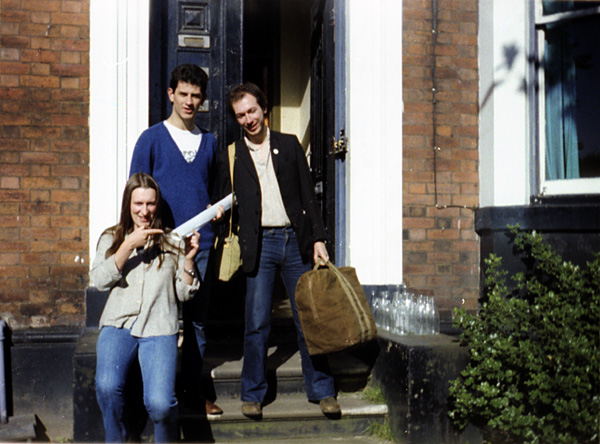
I have recently experienced my own example of what I might call a Wintergarden moment, or perhaps of time as punctum. While searching through old negatives and prints for a particular photograph, I came across a negative which I neither recognised nor remembered. I scanned it, and enlarged it, and in the picture saw myself (my assumption therefore being that Fiona, my wife, is behind the camera), with two old friends: Linda Wilkinson, a long-time-ago nursing colleague of Fiona's, and Andy Bell, an ex-school friend of mine. Andy and I were at boarding school together; we played in the obligatory rock and roll band, and we saw one another infrequently, while he was at University in Sheffield and I was living in Salford. In the photo (from about 1980), we are all standing on the steps to the door of the house where Fiona and I had our first flat; Andy is carrying bags, and from memory, was returning to Sheffield prior to leaving England to take up a job in Zimbabwe. He died not long after in a car accident while working in Zimbabwe.

The photograph was a shock. I do not remember it being taken, but there it is ... "That Has Been". And after all these years, across that great gulf of time and forgetfulness, from that "treasury of rays", there is Andy Bell. Alive and well, yet about to die, and yet dead. A revelation.