Monday, 14 April 2014

Alexander's Ale Festival, 2014

Autumn colour at Alexander's, the Pub at Castle Green

The 2014 Edition of the Alexander's Ale Festival, held in the Function Room of the Castle Green Hotel, got off to a flying start on Friday April 11th. with several of the Bowness Bay beers selling out on night One!  Thankfully, Saturday afternoon started in gently, giving time and space for quiet contemplation of the beers on offer.


Three glasses of beer
 (How did John Smiths Smooth get in there? It's a bloody Beer Festival!)

Top performers, based on a straw-poll of those present, were: Swan Black, from Bowness Bay; Billonde, from Brewshine (apparently made by a man from Kendal in his garage); American Hop from Lancaster Brewery; and (definitely the winner) Angram IPA from Tigertops Brewery in Wakefield. Tigertops is owned by the same people who bring us Foxfield beers from the Prince of Wales pub at Foxfield, and the Angram IPA was a refreshing blast of citrus and hops right from the word go.

 The sun eventually came out, although it was too breezy to sit outside for any length of time. Alexander's, the Pub at the Castle Green Hotel, truly has the finest situation of any pub in Kendal. The Ale Festival, taking place as it does in the Function Room, enjoys much the same view, and when the sun shines, if it's warm enough, you really can't find a better place to enjoy a beer than the hotel lawn.


Live entertainment was supplied by The Mustard Cutters. By common consent, they really "Cut The Mustard" on the night, performing numbers that were clearly popular with the audience, and getting large numbers on the dance floor as the evening went along.

You can see an album of photos of the Ale festival, including lots of The Mustard Cutters, by clicking this link.

Sunday, 18 August 2013

This may not be the real world that we think it is ...

When I was a child, because my Dad was in the army, my family and I spent short periods of time living abroad in a number of different places. This involved a lot of travelling. At that time I had the uncomfortable feeling that we never actually travelled anywhere at all. I couldn't shake the idea that when we got into an aeroplane at, let's say, Luton Airport, and then landed in Germany, we hadn't actually left the ground at all. All that had happened was an unknown group of (possibly alien) manipulators shook the plane around a bit to make it seem like we were flying, and while that was going on, all the scenery and people were moved around. When we got off the plane some hours later, believing ourselves to be in Germany, we were actually still in the same place we had always been - but we didn't recognise it, and all the (maybe alien) people had started to talk in German.

The feeling stayed with me for years (and if I am honest, has never really completely gone away) and was reinforced when I read a sci-fi story about just such a delusion suffered by the main character. In the story, it transpired that he was not deluded, but was really living in a constructed reality as part of a mysterious experiment by aliens. And more recently the film "The Truman Show" has put another spin on a similar theme.


In September 2011, Fiona and I made a visit to Liverpool with friends Susan and Leigh, in part to see an exhibition of works by Rene Magritte at the Tate Liverpool. I was most familiar with Magritte as the author of the painting "La Trahison des Images (Ceci n'est pas une pipe)" ("The treachery of images (This is not a pipe)"). I occasionally used it in Photography classes to encourage students to consider what an image is:

Me (passing round the picture): "What is this?"
Student 1: "It's a pipe."
Me: "Anyone else?"
Student 2: "It's a picture of a pipe."


Back to the Tate exhibition. Much of Magritte's work focusses on the problems of perception, and the pieces in the exhibition that I found particularly fascinating have titles that seem to be significant to their meanings. "Evening Falls" seems an obvious double meaning, referring both to the setting sun outside the window, and to the broken shards of glass littering the floor. "The Human Condition" though, with the easel in front of the window, is more enigmatic. These two pictures, being more 'landscapey' than much of his work, got me thinking about the ideas of place that they aroused in me, and recalled my childhood paranoia about never actually traveling, and which I equate with my uncertainties concerning my control over my life.


This led to the idea for the picture that I have called "Memories of Childhood" (above). When I made the picture, I had not got a photograph of a suitable window; but I remembered that I had some interior views of a Shepherd's Hut from a holiday in Dorset in 2010. I thought that one of the pictures would suffice for a first trial - what would it be like to discover that my fears from all those years ago were justified, and that everything I do is being monitored by some other being, peering in through a gap that occasionally appears in the fabric of our universe? To add to my present confusion, some current thinking about cosmology, and some arguments about perception, lead me to a supposition that the world depicted in the Wachowski Brothers' movie "The Matrix" may not be that far off the mark!

The second image (to the right) is an early attempt at recreating the "Evening Falls" image, made from the view from Susan and Leigh's room in the hotel where we stayed in Liverpool. (Or should that be "made from an image of the view from Susan and Leigh's room in the hotel where we stayed in Liverpool?)

Things are not what they seem.

Monday, 20 May 2013

Another Blog, a sort of Beginner's Photography guide


I have started another blog, based on the beginner's photography classes that I used to run. It is called "Get to Know Photography - Some Basic Principles", and you can find it by clicking on the link.


Monday, 13 May 2013

The Punctum of Time

How the most mundane of snapshots can catch you unawares.

In the opening paragraph of "Camera Lucida", Roland Barthes mentions having seen a photograph of Napoleon's brother, Jerome, taken in 1852. He was amazed to realise that he was "looking at eyes that have looked at the Emperor". Now, this is not meant literally, but it does give rise to thoughts about the way that we are prepared to accept a photograph as being “real” in some sense.

Later, in Chapter 32, he describes photography as proof of the fact that "the thing has been there"; painting can "feign reality", and spoken or written language can deceive, but it can always be said of a photograph: "That Has Been".  The nature of the photographic process means that light from the referent (the original real object or person) creates its image in the photograph. When the image is eventually seen by a spectator (by you or I) that light from the referent, delayed by a period of time, finally reaches the spectator. Barthes describes a photograph as "literally an emanation of the referent". Again, this light from the referent is not literally the same light that, passing from the referent to the film emulsion, caused the original exposure. This idea of ‘deferred light’, finally reaching its eventual audience, is more concerned with the fact that every photograph is inevitably of the past. However, there are quantum physicists who might argue that, because one photon is practically indistinguishable from another, there is no way to prove that the light emanating from the photograph is not the same as that from the original exposure.

In the latter part of the book Barthes is discussing a photograph (referred to as the Wintergarden photograph) of his (recently deceased) mother as a young girl. We are not shown the photograph, a snapshot, since Barthes considers that it would appear mundane to anybody but himself, and thus appear incomprehensible as an example of an important photograph. Yet in studying the photo, he "rediscovered" his mother in "the treasury of rays which emanated from my mother as a child, from her hair, her skin, her dress, her gaze, on that day".

Lewis Payne, by Alexander Gardner, 1865
In chapter 39 there is a photograph, taken by Alexander Gardner in 1865, of Lewis Payne in his prison cell awaiting execution. Barthes had the realisation that, in addition to the punctum of 'the detail', there can be, as in this photograph of Lewis Payne, a punctum 'of Time'. In the photograph (evidence of "That Has Been") he is alive and well; however, we are also aware that, at the moment that the photograph was exposed, he is about to die, and that he is dead (in the here and now), and has been for many years.

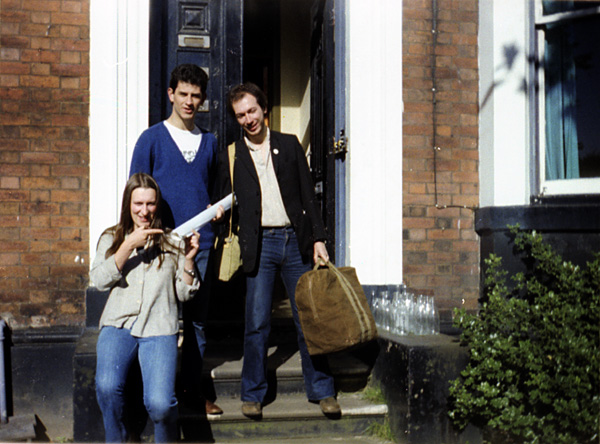
I have recently experienced my own example of what I might call a Wintergarden moment, or perhaps of time as punctum. While searching through old negatives and prints for a particular photograph, I came across a negative which I neither recognised nor remembered. I scanned it, and enlarged it, and in the picture saw myself (my assumption therefore being that Fiona, my wife, is behind the camera), with two old friends: Linda Wilkinson, a long-time-ago nursing colleague of Fiona's, and Andy Bell, an ex-school friend of mine. Andy and I were at boarding school together; we played in the obligatory rock and roll band, and we saw one another infrequently, while he was at University in Sheffield and I was living in Salford. In the photo (from about 1980), we are all standing on the steps to the door of the house where Fiona and I had our first flat; Andy is carrying bags, and from memory, was returning to Sheffield prior to leaving England to take up a job in Zimbabwe. He died not long after in a car accident while working in Zimbabwe.

The photograph was a shock. I do not remember it being taken, but there it is ... "That Has Been". And after all these years, across that great gulf of time and forgetfulness, from that "treasury of rays", there is Andy Bell. Alive and well, yet about to die, and yet dead. A revelation.


Wednesday, 24 April 2013

Rob Freeman's House


If you look at the list of links down at the bottom of this page, you will notice that I have recently added a link to Rob Freeman Building. Rob is a long-time friend of mine from school days, and now lives down in Devon. He runs his own construction company, specialising in conservation and renovation using old-time traditional techniques and materials. As a billboard, demonstrating the kind of work his company does, is his own house (pictured here) which is a combination of the original dormer building and the modern extension, enlarged to accommodate Rob's family.


The first set of photos are from New Year's Eve a few years ago, showing paper lanterns placed around the ornamental pond, situated on the patio in the back garden. The attraction of the scene, to me, was the presence of the reflections in the mirror-calm of the water. The camera that I was using for these shots was a long-in-the-tooth Nikon D100, with non-functioning light meter, and which worked only in manual mode. (I mention this by way of excusing the variation in exposure of the pictures, even though this does not necessarily work to their detriment).

It is true (as noted by some of my photographic friends) that I have something of a preoccupation with reflections. I would say, in my defence, that I am not alone in this. Henri Cartier-Bresson's "Gare St. Lazare", and many of Ansel Adams' landscapes demonstrate some classic examples of reflections within the historical canon of photography. In my case, the fascination lies within the 'image within an image' aspects of the pictures, and the tricks our minds play on us when we 'look' (with our eyes) at a reflection, then 'look again' when we examine the photograph some time later. Suffice to say, given the limitations of the camera record of a scene (particularly one recorded in low light) what I remember of the scene as seen by the naked eye bears little resemblance to the photographic images. This is generally due to the lack of recorded detail in the deep shadow areas, which because of the nature of reflections in water, tends to be within the reflection areas of the picture.


An example of so-called 'diffraction flare', a photographic phenomenon unique to digital cameras
However, that is not the major interest that I have in these images. I had spotted before, but not paid significant attention to, the phenomenon illustrated in the images above. I have encountered (and combatted) flare for most of my photographic life (and will be posting an article on flare in the near future), so I am familiar with it, and its manifestations in the viewfinder. The coloured blobs, clearly seen in all of the images above, and which I had previously assumed to be flare, were not visible in the viewfinder. This indicates that the artefacts (the coloured blobs) cannot be a lens-related occurrence.

The more I thought about it, particularly the fact that all of the blobs feature the three primary colours red, green and blue, the more I came around to considering the reseau, or Bayer filter, that is incorporated into the digital sensor at the heart of a digital camera. (The link below is one of the many places on the Internet that a description of the structure of a digital sensor can be found).

http://en.wikipedia.org/wiki/Charge-coupled_device

More research has led me to the revelation that the phenomenon is indeed linked to the image sensor (and that it is unique to digital photographs) and is caused by diffraction of high intensity light rays by the pixel structure of the sensor array. This article on Wikipedia mentions it (near the bottom of the page) and even comments on the fact that it is not visible in the viewfinder.

http://en.wikipedia.org/wiki/Lens_flare

Who says you can't teach old dogs new tricks?


I will conclude with some pictures of the house, taken in daylight last November. Good weather always makes a photograph look more attractive, and being on holiday (which I invariably am when visiting Rob) makes the process of photographing very pleasurable. However, while the physical comfort of having the warmth of the sun on your back makes photography enjoyable, clear blue skies can mean death to a photograph. Even though a photographer may not have the choice (ultimately you photograph under the circumstances that you find on the day) a few clouds can make all the difference to the appearance of a picture. Most of the time, this just means that I will have to go back and try again on another day.